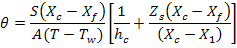
2. THEORICAL FOUNDATIONS
2.2 Drying rate
Drying rate is defined by the loss of moisture from the wet solid per each unit of time, and more especifically by the differential quotient (-dX/dθ) operating in constant drying conditions, when are air-conditions (temperature, pressure, humidity and velocity) are constant along time.
Analytically, drying rate refers to the unit area of surface drying, according to the equation:
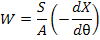
Where :
S = weight of dry solid;
A = the surface area exposed;
W = drying rate;
 = difference of humidity with regard to time.
There are two different periods of drying rate:
A) Critical period ahead or constant speed drying : During this period the solid surface is completely covered by a layer of liquid and evaporation which depends only on the speed of diffusion of steam or intense heat passing through the boundary layer of air. This speed drying is given by:

Where:
 = coefficient of transport of mass
 = moisture in the interface
Y= moisture within the air
Knowing the intensity of heat transfer, if heat is used exclusively to evaporate the moisture, drying rate is given by:
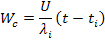
Where U = integral coefficient of heat transmission
 = latent heat of vaporization of the liquid at the interface temperature
 and t are the temperature within the air
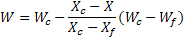
B) Critical period post: In general, this period can be divided in two sections: one in which the drying rate varies linearly with moisture from the critical point (critical early period post), and one that does not meet the linear variation (second post-critical period), although this may not appear clear separation between the two sections. During the first critical period after the drying rate is governed by the evaporation of water on the surface wet fraction and this fraction decreases continuously until the end of this period the surface is dry. You can calculate the drying rate at any point during this period depending on the speed and humidity and final review for that period, according to the equation:
During the second period after the critical surface is completely dry and the drying rate must be evaluated according to the process of removal of moisture from the interior of the solid to the surface, which can be performed by various mechanisms. If the transport mechanism is carried out by diffusion (case of continuous solid structure such as soaps, wood, paper, etc.). The drying rate is given by:
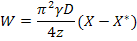
And the humidity drying time between X1 and X2 will be:
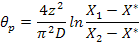
γ being the weight of the solid dry in kilograms per cubic meter, the thickness z, m, D the diffusivity, square meters per hour.
In the case that transport mechanism is controlled by capillary flow (case of granular solids such as sand, pigment, etc.). Drying time between the humidity X1 and X2 is given by the equation:

In which it is assumed that the drying rate varies linearly with moisture until it reaches the equilibrium.
For solids of uniform capillary structure when the capillaries are very small and the structure does not change during drying, evaporation zones are reduced uniformly in the material duringcritical period post , and these areas remain with humidity and temperature equal to the critical temperature equal to the wetland. At any instant, the thickness of the layer is dry and moisture-related X-expression:

The integral coefficient of heat transmission between the air flowing over the surface of the solid and the evaporation zone is given by:

And the drying rate will be:
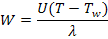
Combining these two equations is:

And according to this expression the drying time will be: